How The Genius Wave Works A Beginner’s Guide to Brainwave Audio
How The Genius Wave Works A Beginner’s Guide to Brainwave Audio
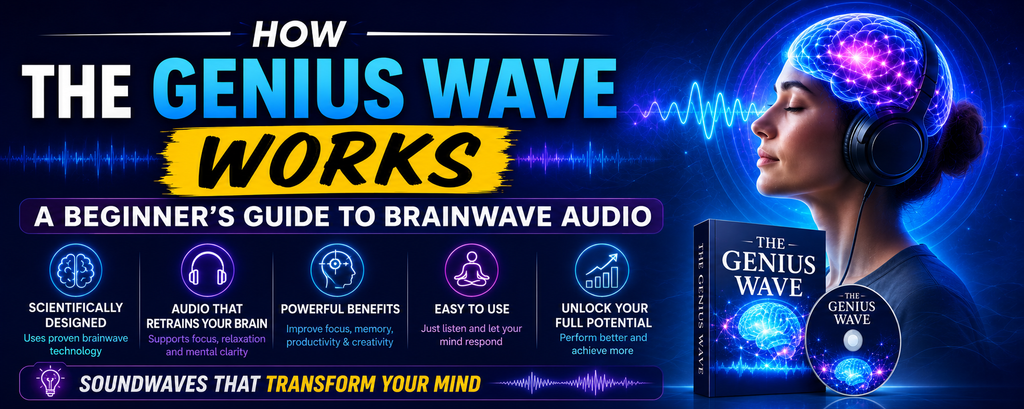
If you’ve come across The Genius Wave online, you’ve likely seen bold claims about “unlocking” focus and creativity in just minutes a day. Before deciding whether that’s worth your time or money, it helps to understand the actual technology behind it — brainwave entrainment — separate from the marketing built on top of it. This guide breaks down how the underlying audio science works, what The Genius Wave specifically claims to do with it, and where the evidence is (and isn’t) solid.
What Is Brainwave Entrainment?
Brainwave entrainment is the idea that rhythmic sensory input — usually sound, sometimes light — can influence the electrical activity of the brain to move toward a matching frequency. It’s built on real, measurable brain activity: your brain naturally produces different types of electrical waves depending on your mental state, and entrainment audio is designed to nudge activity toward a specific one of these states.
The main brainwave categories referenced in this kind of audio are:
- Delta waves — deep, dreamless sleep
- Theta waves — light meditation, deep relaxation, and drowsy, dreamlike creativity
- Alpha waves — calm, relaxed wakefulness
- Beta waves — normal, alert waking thought and focus
- Gamma waves — high-level cognitive processing and problem-solving
The Genius Wave specifically markets itself around theta waves, framing that state as the key to “childlike” learning ability and creative insight.
The Two Main Techniques: Binaural Beats and Isochronic Tones
Most brainwave entrainment audio, including The Genius Wave, relies on one or both of these techniques:
Binaural beats play two slightly different frequencies in each ear — for example, 200 Hz in the left ear and 210 Hz in the right. Your brain perceives the difference between them (10 Hz in this example) as a phantom third tone, and the theory is that your brainwaves gradually sync to that difference frequency. This requires stereo headphones to work as intended, since the effect depends on each ear receiving a distinct tone.
Isochronic tones use a single tone that pulses on and off at a set rate, rather than blending two frequencies. Because the pulsing rhythm itself is what your brain responds to, isochronic tones don’t require headphones the way binaural beats do, though many programs still recommend them for a more immersive experience.
How The Genius Wave Specifically Claims to Use This
According to its marketing, The Genius Wave is a short daily audio track — commonly cited as 7 to 20 minutes — combining binaural beats and isochronic tones tuned toward theta-range frequencies. The pitch is straightforward: listen daily with headphones, and the audio gradually shifts your brain from a stressed or distracted state into the theta range associated with relaxed, creative thinking.
The basic listening process described across its marketing looks like this:
- Find a quiet space and put on stereo headphones (required for the binaural beat component to work as intended).
- Play the track once daily, ideally at a consistent time, such as first thing in the morning.
- Let your mind wander or stay passively focused rather than actively concentrating — the theta state is associated with relaxed, unforced attention.
- Repeat consistently, since entrainment audio is generally framed as a cumulative practice rather than a one-time fix.
What’s Solid Science, and What’s Marketing
It’s worth separating these two things clearly:
Reasonably well-supported: Binaural beats and isochronic tones are real, studied audio phenomena, and some research suggests they can support relaxation, reduced anxiety, and a calmer mental state for at least some listeners. This part of the underlying technology isn’t fringe.
Not well-supported: The leap from “may support relaxation” to marketing claims about dramatically unlocking genius-level creativity, reactivating childhood learning ability, or fundamentally boosting IQ-adjacent performance goes considerably further than the research on brainwave entrainment currently backs up. Individual results in the research that does exist also vary a lot from person to person.
It’s also worth knowing that The Genius Wave isn’t the only source of this kind of audio — free binaural beat and isochronic tone tracks tuned to theta frequencies are widely available on YouTube and meditation apps, using the same underlying mechanism.
A Few Practical Notes for Trying Brainwave Audio (From Any Source)
If you’re curious about trying brainwave entrainment audio generally, a few things are worth knowing regardless of which specific track or program you use:
- Headphones matter for binaural beats specifically. Without stereo separation, the binaural effect doesn’t work as designed.
- Consistency is emphasized more than intensity. Most entrainment audio is framed as a daily practice, not a one-time trigger.
- Effects are typically subtle, not dramatic. Treat it as a relaxation or focus aid, not a substitute for sleep, deep work, or actual cognitive training.
- Be skeptical of “unlock your genius” framing from any brand — the underlying audio science doesn’t support claims that dramatic.
The Bottom Line
Brainwave entrainment through binaural beats and isochronic tones is a real, if modest, tool for relaxation and focus — and that’s genuinely the mechanism The Genius Wave is built on. But it’s worth going in with realistic expectations about what this kind of audio can and can’t do, separate from the more dramatic marketing claims attached to any specific branded product. If you do decide to explore this category, it’s worth researching the specific product or company’s reputation first — some brainwave audio programs, including The Genius Wave, have drawn consumer-protection warnings that are worth factoring into any purchase decision.
This article is educational and explains the general mechanism behind brainwave entrainment audio, along with how The Genius Wave specifically markets itself. It is not medical advice and is not an endorsement of any specific product.