The Genius Wave vs. Meditation Which Is Better for Focus and Relaxation?
The Genius Wave vs. Meditation Which Is Better for Focus and Relaxation?
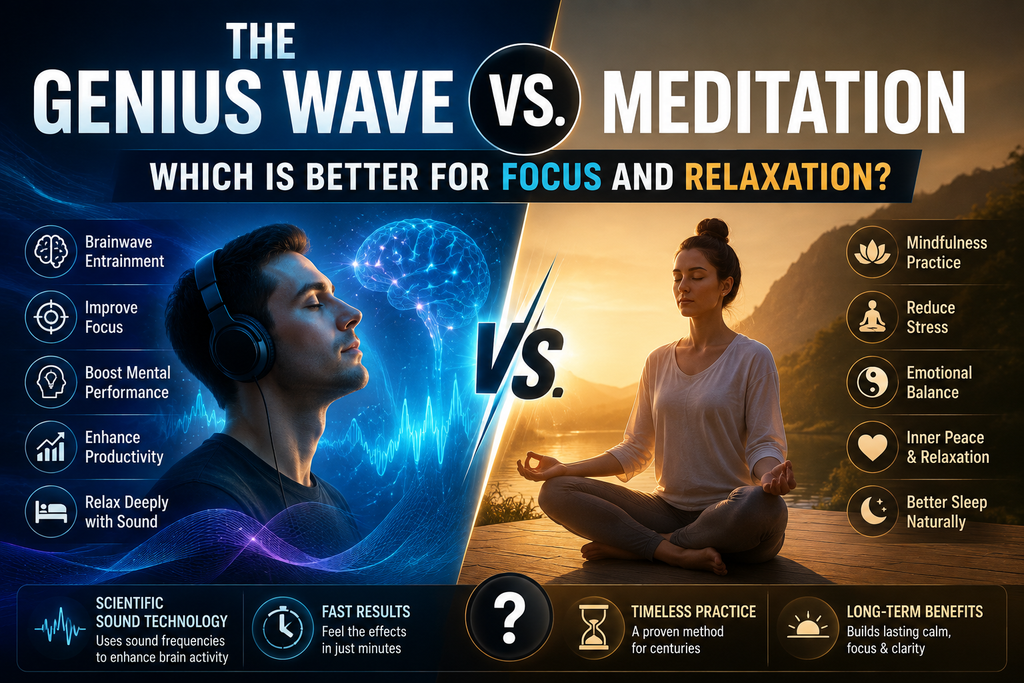
If you’re looking for a way to sharpen focus and unwind, you’ve likely run into two very different-sounding options: The Genius Wave, a packaged brainwave-audio product, and meditation, a practice with thousands of years of history and a substantial modern research base. They’re often marketed as competing solutions, but they’re not quite apples to apples. Here’s how they actually compare.
What Each One Is
The Genius Wave is a commercial audio program built around brainwave entrainment — the idea that specific sound frequencies can nudge your brain toward a theta state associated with relaxation and creative thinking. It’s sold as a roughly 7-minute daily listen, usually paired with a guide explaining the underlying theory, and marketed with claims about “unlocking genius” and replicating mental states used by high performers.
Meditation is a mental practice — most commonly mindfulness or focused-attention meditation — that trains attention and awareness through deliberate practice, typically without any special equipment. It ranges from a few minutes of breath-focused sitting to longer structured sessions, and it’s been studied extensively across psychology and neuroscience.
The Evidence Behind Each
This is where the two diverge the most.
Meditation’s evidence base is substantial and well-established. Decades of peer-reviewed research, including numerous randomized controlled trials, link regular meditation practice to measurable reductions in anxiety and stress, improvements in sustained attention, and changes in brain structure and activity associated with emotional regulation. It’s used in clinical settings (mindfulness-based stress reduction, for instance) precisely because the evidence supporting it is robust enough for that context.
The Genius Wave’s evidence is thinner and less specific. Brainwave entrainment as a general concept is a legitimate, if still-developing, area of neuroscience — some studies do show mild effects on relaxation, sleep, or attention from binaural beats and similar audio techniques. But claims specific to this product, including dramatic cognitive transformation and comparisons to Nobel laureates’ mental states, aren’t backed by independent, peer-reviewed research on the product itself. The instructor credentials cited in its marketing also aren’t independently verifiable outside the product’s own promotional material.
Bottom line on evidence: meditation has decades of independently replicated research behind it; The Genius Wave rests on a real but more general scientific concept (brainwave entrainment) stretched by marketing into claims the evidence doesn’t fully support.
Time and Effort
This is where The Genius Wave has a real, practical advantage. Meditation typically requires:
- Learning a technique (even basic mindfulness has a learning curve)
- Building consistency over weeks or months before effects become noticeable
- Managing a wandering mind, which many beginners find frustrating early on
The Genius Wave, by contrast, is designed to be passive — you press play and listen for about seven minutes, with no technique to learn. For someone who has repeatedly tried and abandoned meditation, that lower barrier to entry is a genuine point in its favor, even if the underlying science is less rigorously validated.
Cost
Meditation can be entirely free — countless free guided meditations and instructional resources exist, and the practice itself requires no purchase at all. Paid meditation apps exist for convenience, but they’re optional.
The Genius Wave is a paid product. You’re paying for packaging, structure, and the accompanying guide — not for a mechanism unavailable elsewhere, since free binaural beat and theta-wave audio tracks are widely available online.
Relaxation
Both can genuinely help you relax, through different pathways:
- Meditation builds a durable skill — the ability to notice and redirect your attention — that tends to generalize beyond the practice session itself, helping with stress reactivity throughout the day.
- Brainwave audio like The Genius Wave works more passively, potentially shifting your state during the listening session itself, similar to how calming music or ambient sound can help you unwind, without necessarily building a transferable skill.
If your goal is a quick reset in the moment, brainwave audio may get you there faster. If your goal is long-term stress resilience, meditation’s track record is stronger.
Focus
For sustained, transferable focus improvements, meditation again has the deeper evidence base — attention training is essentially what mindfulness meditation practices. Brainwave audio aimed at alpha or low-beta frequencies may support a temporary state of calm alertness during the listening session or shortly after, but there’s limited evidence that it builds lasting attentional capacity the way regular meditation practice appears to.
Which Should You Choose?
Consider meditation if:
- You want a well-researched, free option with a strong long-term evidence base
- You’re willing to invest a few weeks of practice before expecting noticeable results
- You want a skill that helps beyond just the practice session itself
Consider brainwave audio (Genius Wave or similar) if:
- You’ve struggled to stick with meditation and want something more passive
- You’re looking for a quick relaxation aid rather than a long-term attention-training practice
- You approach the marketing claims skeptically and treat it as a mood/focus aid, not a scientifically proven intelligence booster
Or combine them. There’s no rule against using brainwave audio as a low-effort relaxation tool on busy days while still building a meditation habit for the deeper, more evidence-backed benefits. They’re not mutually exclusive — one is a passive listening aid, the other is an active mental skill, and they address overlapping but distinct needs.
The Bottom Line
Meditation has the stronger, more independently verified evidence base for both focus and relaxation, and it costs nothing. The Genius Wave (and brainwave audio products like it) offers a lower-effort entry point built on a legitimate but oversold scientific concept — useful as a supplementary relaxation tool, but not a substitute for meditation’s track record if genuine, lasting improvement is the goal.
This article is for general informational purposes and is not medical advice. If you’re dealing with a diagnosed anxiety, attention, or mental health condition, consult a qualified healthcare professional before relying on either approach as treatment.